Aggregation
Aggregation is a critical quality attribute for biologics, viral vectors and nanoparticle-based products, with direct implications for stability, potency, immunogenicity and lot-to-lot consistency. Bulk techniques such as SEC, DLS or AUC report an overall aggregate content, but not the morphology of the aggregated species.
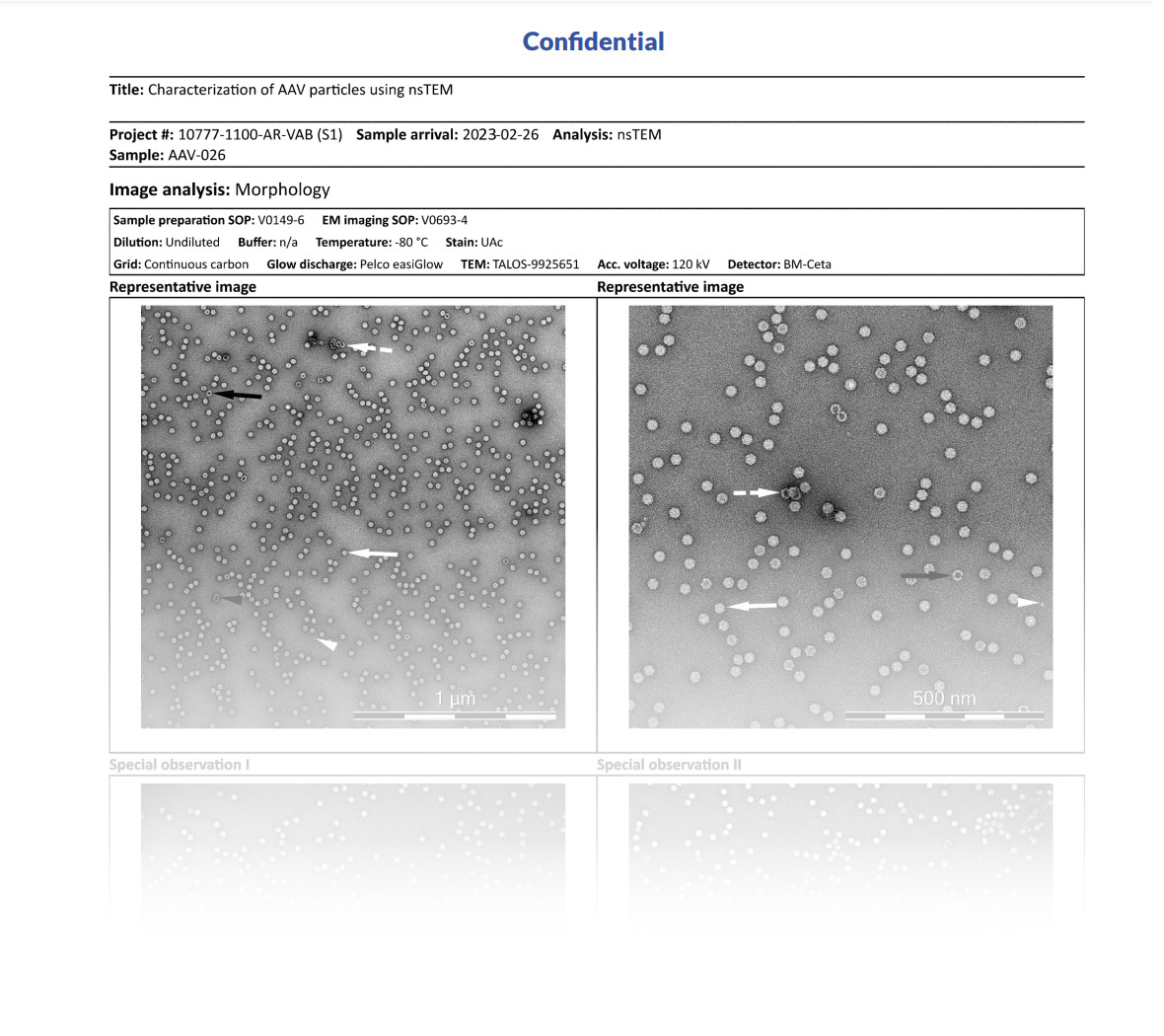
Electron microscopy resolves individual particles, but image-based aggregation analysis has long relied on negative-stain TEM, which is exposed to two sources of bias: staining and drying artifacts, and the difficulty of distinguishing genuine aggregates from particles merely in close proximity.
QuTEM’s aggregation workflow addresses both limitations. Samples are imaged by cryoTEM, in a vitrified, near-native state that avoids staining and drying artifacts and preserves particle structure and spatial distribution.
Image analysis then relies on two complementary tools: a Classification Tool, which sorts particles into individual particles, dimers and higher-order aggregates based on morphological criteria, and a Statistical Tool, which compares the nearest-neighbor distance of each particle with a fitted reference distribution to discriminate true aggregation from random proximity.
Used separately or in combination, these approaches deliver an objective, quantitative assessment of aggregation at the single-particle level. Each result remains traceable to the underlying images, so that numerical trends can be linked to the morphology of the species involved. These features make the analysis well suited to formulation and process development, forced-degradation and stability studies, and batch-to-batch comparison, while complementing bulk methods when an orthogonal, image-based perspective is needed.
For more information, watch our webinar: A new approach to AAV aggregation analysis
Method 1 - Classification Tool

Method 2 - Statistical Tool

Methods at a glance
The Classification Tool is the method of choice when structural insight into the aggregated species is needed, while the Statistical Tool is best suited to comparing conditions, time points or batches. For a complete characterization, both can be applied to the same dataset.
Classification Tool
Categorizes particles into defined aggregate classes
Provides structural interpretation of clusters
Enables detailed population breakdown
Well suited for mechanistic and structural studies
Supports correlation with particle-specific attributes
Statistical Tool
Assesses aggregation at the global population level
Uses fitted reference curves for objective evaluation
Detects subtle distribution shifts
Minimizes classification subjectivity
Ideal for comparative and trend analyses
Examples
At QuTEM, the aggregation analysis is typically performed for the following particle types:


Example reports
Download an example report that includes:
- Analysis of an AAV sample
- Size analysis and aggregation evaluation